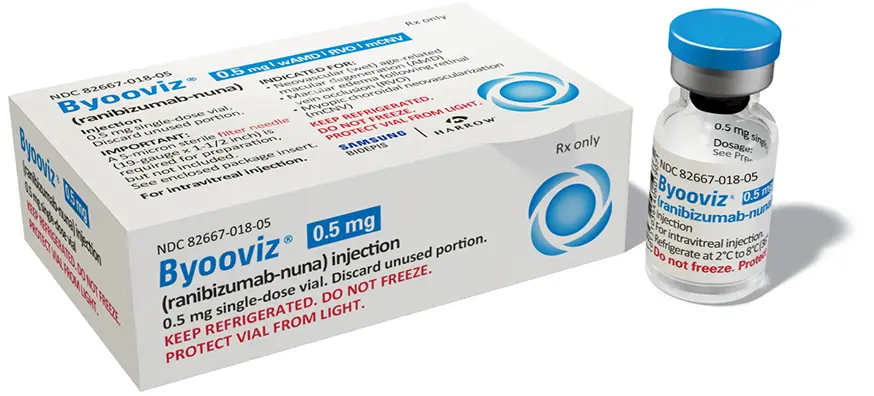
What is BYOOVIZ® (ranibizumab-nuna)
injection?
BYOOVIZ® is a prescription medicine for the
treatment of patients with:
-
Neovascular (Wet) Age-Related Macular Degeneration (AMD)
- Macular Edema Following Retinal Vein Occlusion (RVO)
- Myopic Choroidal Neovascularization
IMPORTANT SAFETY INFORMATION
What Important Safety Information should I know about BYOOVIZ?
You should not use BYOOVIZ if you have an infection in or around
the eye or are allergic to ranibizumab products or any of the
ingredients in BYOOVIZ.
BYOOVIZ is a prescription medication given by injection into the
eye, and it has side effects.
BYOOVIZ can cause serious side effects, including:
-
Detached retinas and serious eye infections.
If your eye becomes red, sensitive to light, or painful, or
if you have a change in vision, call or visit your
healthcare provider right away
-
Increased eye pressure. Some patients have
had increases in eye pressure before and within 1 hour of an
injection. Your healthcare provider should check your eye
pressure and eye health before and after your BYOOVIZ
injection
-
Heart attacks or strokes. There is a
potential risk of serious, sometimes fatal, problems related
to blood clots, such as heart attacks or strokes
-
Severe inflammation of vessels in the retina, with or
without blockage,
have been reported with the use of ranibizumab products.
Call your healthcare provider immediately if you experience
any changes in vision
-
Some patients using ranibizumab products have serious side
effects related to the injection. These include serious
infections inside the eye, detached retinas, and cataracts
The most common eye-related side effects include:
- Increased redness in the white of the eye
- Eye pain
- Small specks (floaters) in vision
- Increased eye pressure
The most common non–eye-related side effects are nose and throat
infections, anemia, nausea and cough.
You are encouraged to report suspected adverse reactions to the
FDA. Visit
www.fda.gov/medwatch, or call 1-800-FDA-1088.
Please see full
Prescribing Information.